In Germany, we’re fortunate to have strong data privacy laws. For small businesses handling sensitive data in the era of remote work, it’s crucial to have a secure server based locally. I built a small business network optimized for remote work and security. From setting up secure workstations to implementing top-notch backup solutions, I ensured compliance with regulations and customer expectations. Adding montioring with CheckMK I ensure to keep things running smooth.
Category: Projekt
Projekte
-
![Gottor – Exploring the Depths of the Dark Web]()
Gottor – Exploring the Depths of the Dark Web
Gottor – Exploring the Depths of the Dark Web
![drawing]()
Welcome to the realm of the hidden, where shadows dance and whispers echo through the digital corridors. Enter Gottor, a testament to curiosity, innovation, and a touch of madness. In this blog post, we embark on a journey through the creation of Gottor, a bespoke dark web search engine that defies convention and pushes the boundaries of exploration.
![drawing]()
Genesis of an Idea
The genesis of Gottor traces back to a spark of inspiration shared between friends, fueled by a desire to unveil the secrets lurking within the depths of the dark web. Drawing parallels to Shodan, but with a cloak of obscurity, we set out on a quest to build our own gateway to the clandestine corners of the internet.
Forging Custom Solutions
Determined to forge our path, we eschewed conventional wisdom and opted for custom solutions. Rejecting standard databases, we crafted our own using the robust framework of BleveSearch, laying the foundation for a truly unique experience. With a simple Tor proxy guiding our way, we delved deeper, fueled by an insatiable thirst for performance.
However, our zeal for efficiency proved to be a double-edged sword, as our relentless pursuit often led to blacklisting. Undeterred, we embraced the challenge, refining our approach through meticulous processing and data extraction. Yet, the onslaught of onion sites proved overwhelming, prompting a shift towards the versatile embrace of Scrapy.
![drawing]()
The Turning Point
Amidst the trials and tribulations, a revelation emerged – the adoption of Ahmias’ tor proxy logic with Polipo. Through the ingenious utilization of multiple Tor entry nodes and a strategic round-robin approach, we achieved equilibrium, evading the ire of blacklisting and forging ahead with renewed vigor.
The Ethical Conundrum
As our creation took shape, we faced an ethical conundrum that cast a shadow over our endeavors. Consulting with legal counsel, we grappled with the implications of anonymity and the responsibility inherent in our pursuit. Ultimately, discretion prevailed, and Gottor remained veiled, a testament to the delicate balance between exploration and accountability.
![drawing]()
Unveiling the Web of Intrigue
In our quest for knowledge, we unearthed a web of intrigue, interconnected and teeming with hidden services. By casting our digital net wide, we traversed the labyrinthine pathways, guided by popular indexers and a relentless spirit of inquiry. What emerged was a tapestry of discovery, illuminating the clandestine landscape with each query and click.
Lessons Learned
Through the crucible of creation, we gained a newfound appreciation for the intricacies of search engines. While acquiring and storing data proved relatively straightforward, the true challenge lay in making it accessible, particularly amidst the myriad complexities of multilingual content. Yet, amidst the obstacles, we discovered the essence of exploration – a journey defined by perseverance, innovation, and the relentless pursuit of knowledge.
In conclusion, Gottor stands as a testament to the boundless curiosity that drives us to explore the uncharted territories of the digital realm. Though shrouded in secrecy, its legacy endures, an embodiment of the relentless pursuit of understanding in an ever-evolving landscape of discovery.
Explore. Discover. Gottor
.
![drawing]()
Although we have not talked in years. Shoutout to my good friend Milan who helped make this project possible.
-
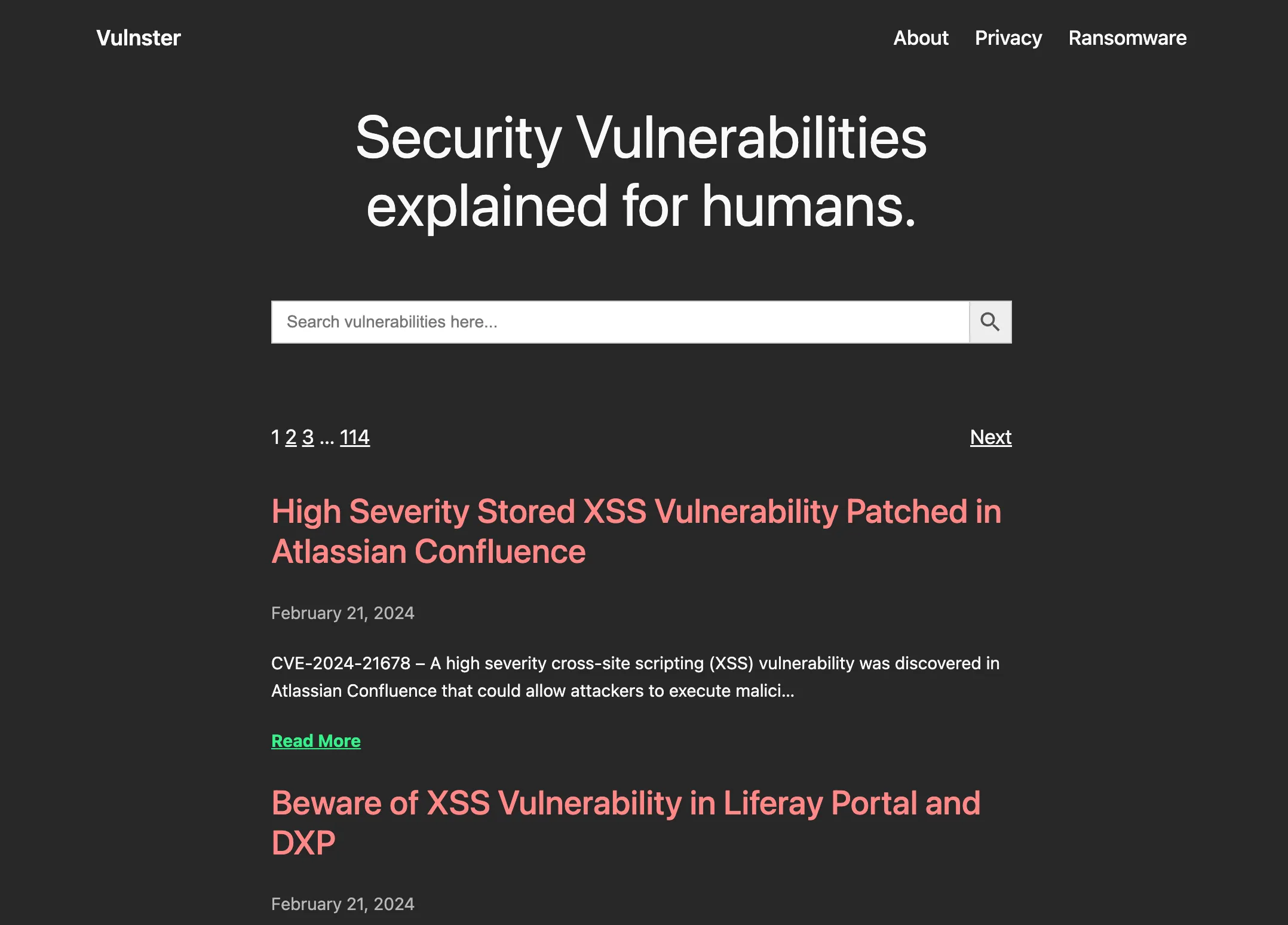
![Vulnster – CVEs explained for humans.]()
Vulnster – CVEs explained for humans.
Vulnster – CVEs explained for humans
Have you ever stumbled upon a CVE and felt like you’d entered an alien realm? Let’s decode it with an example:
CVE-2023-6511.CVE-2023-6511: Before version 120.0.6099.62 of Google Chrome, there’s a glitch in Autofill’s setup. This glitch lets a crafty hacker bypass Autofill safeguards by simply sending you a specially designed webpage. (Chromium security severity: Low)
Now, if you’re not a cyber expert, this might seem like a cryptic message urging you to update Chrome ASAP. And you know what? Updating is usually a smart move! But what if you’re curious about how cyber villains can exploit this weakness in a way that even your grandma could grasp?
That’s where Vulnster steps in – Your Go-To Companion for Understanding CVEs, translated into plain language by some nifty AI.
So, I delved into experimenting with AWS Bedrock after reading about Claude and feeling a bit fed up with ChatGPT (not to mention, Claude was more budget-friendly).
I kicked things off by setting up a WordPress site, pulling in all the latest CVEs from the CVEProject on GitHub. Then, I whipped up some code to sift through the findings, jazzed them up with Generative AI, and pushed them out into the world using the WordPress API.
WordPress
I have a soft spot for WordPress. Over the years, I’ve crafted countless WordPress sites, and let me tell you, the ease of use is downright therapeutic. My go-to hosting platform is SiteGround. Their performance is stellar, and when you pair it with Cloudflare cache, you can hit a whopping 95% cache success rate, ensuring lightning-fast page loads.
But you know what really seals the deal for me with SiteGround? It’s their mail server. They offer unlimited mail accounts, not just aliases, but full-fledged separate mailboxes. This feature is a game-changer, especially when collaborating with others and needing multiple professional email addresses.
WordPress often takes a hit for its security and performance reputation, but if you know how to set it up correctly, it’s as secure and snappy as can be.
Python
Python Passion
Let me tell you, I have a deep-seated love for Python. It’s been my faithful coding companion for over a decade now. Back in the day, I dabbled in Objective-C and Java, but once I got a taste of Python, there was no turning back. The simplicity and conciseness of Python code blew my mind. It’s incredible how much you can achieve with so few lines of code.
Python has a lot going for it. From its readability to its extensive library ecosystem, there’s always something new to explore. So naturally, when it came to bringing this project to life, Python was my top choice.
Here’s just a glimpse of what Python worked its magic on for this project:
- Fetching and parsing CVEs effortlessly.
- Seamlessly interacting with AWS through the Bedrock API.
- Crafting the perfect HTML for our latest blog post.
- Smoothly pushing all the updates straight to WordPress.
Python’s versatility knows no bounds. It’s like having a trusty Swiss Army knife in your coding arsenal, ready to tackle any task with ease.
AWS & Claude
In my quest for better answers than what I was getting from ChatGPT, I stumbled upon a gem within the AWS ecosystem. Say hello to PartyRock, a playground for exploring various AI models. Among them, one stood out to me: Claude.
Claude’s capabilities and flexibility really impressed me, especially when compared to what I was getting from ChatGPT. Plus, I needed more input tokens than ChatGPT allowed back then, and Claude came to the rescue.
Now, here comes the fun part. I’m more than happy to share the entire code with you:
import re
import json
import boto3


class Bedrock:
    def __init__(
        self, model="anthropic.claude-instant-v1", service_name="bedrock-runtime"
    ):
        self.model = model
        self.service_name = service_name

    def learn(
        self,
        description,
        command="",
        output_format="",
        max_tokens_to_sample=2048,
        temperature=0,
        top_p=0,
        top_k=250,
    ):
        brt = boto3.client(service_name=self.service_name)

        cve_description = description

        if not command:
            command = "Write a short SEO optimized, blog post explaining the vulnerability described in the above paragraph in simple terms. Explain the technology affected and the attack sezanrio used in general. Provide recommendations on what users should do to protect themselves."

        if not output_format:
            output_format = "Output the blog post in <blogpost></blogpost> tags and the heading outside of it in <heading></heading> tags. The heading should get users to click on it and include the Name of the affected Tool or company."

        body = json.dumps(
            {
                "prompt": f"\n\nHuman: <paragraph>{cve_description}</paragraph>\n\n{command}\n{output_format}\n\nAssistant:",
                "max_tokens_to_sample": max_tokens_to_sample,
                "temperature": temperature,
                "top_p": top_p,
                "top_k": top_k,
            }
        )

        accept = "application/json"
        contentType = "application/json"

        response = brt.invoke_model(
            body=body, modelId=self.model, accept=accept, contentType=contentType
        )

        response_body = json.loads(response.get("body").read())

        return response_body.get("completion")

    def article(self, content):
        heading_pattern = re.compile(r"<heading>(.*?)</heading>", re.DOTALL)
        body_pattern = re.compile(r"<blogpost>(.*?)</blogpost>", re.DOTALL)

        heading_matches = heading_pattern.findall(content)
        body_matches = body_pattern.findall(content)

        if heading_matches and body_matches:
            return {
                "heading": heading_matches[0].strip(),
                "body": body_matches[0].strip(),
            }

        return None
And deploying it? Piece of cake! It’s as simple as:
ai = Bedrock()
output = ai.learn(description=cve_description)
article = ai.article(output)
Voilà! Easy peasy.
It’s worth noting that there might be newer models out there now that could potentially outshine Claude. I’ve spent quite some time experimenting with different prompts, and now I’m passing the torch to you. Go ahead and explore, my friend. The world of AI awaits.
Example
Wondering if AI can churn out readable blog posts all by itself? Well, here’s a sneak peek at one generated in autorun mode:
CVE-2024-21678: High Severity Stored XSS Vulnerability Patched in Atlassian Confluence
CVE CVE-2024-21678 CVSS cvssV3_0: 8.5 Source CVE-2024-21678 A high severity cross-site scripting (XSS) vulnerability was discovered in Atlassian Confluence that could allow attackers to execute malicious scripts on users’ browsers.
Confluence is a popular enterprise collaboration and documentation tool. The vulnerability affected versions between 2.7.0 to the latest version at the time and had a CVSS score of 8.5 out of 10, indicating a high risk.
Stored XSS vulnerabilities occur when untrusted data is saved to and then displayed from a database without being sanitized. In Confluence, an authenticated attacker could craft a malicious HTML or JavaScript payload and store it in the application. When other users viewed the content, their browsers would execute the script from the Confluence server.
This could allow the attacker to steal users’ login cookies or other sensitive information, use the browser to perform actions on the attacker’s behalf, or redirect users to malicious sites. No user interaction would be required once the script is stored.
Atlassian has released patches for all affected versions of Confluence. Users are strongly recommended to upgrade immediately to the latest version or supported fixed release listed for their installation. Regularly applying security updates is also important to protect against vulnerabilities like this.
By keeping software updated with the latest patches, users can help prevent the exploitation of vulnerabilities and ensure the security of their data and systems.
References
- https://confluence.atlassian.com/pages/viewpage.action?pageId=1354501606
- https://jira.atlassian.com/browse/CONFSERVER-94513
Summary: Learning and Reflection
In the course of this project, I delved into the realms of prompt engineering, explored the capabilities of the AWS Bedrock SDK, tinkered with the WordPress API, and, unsurprisingly, didn’t uncover anything groundbreaking about Python – but hey, I still enjoyed every bit of programming.
Initially, I harbored dreams of monetizing the website through a barrage of ads, envisioning myself swimming in riches from millions of clicks. Alas, reality had other plans. Nonetheless, this endeavor served as a shining example of how AI can simplify complex concepts, aiding human comprehension and learning – a definite win in my book.
Despite the relatively modest cost of running Claude and my script locally on my Pi as a cron job (clocking in at around 3 Euro a month), the venture failed to yield any financial returns. Consequently, I made the tough decision to pull the plug. Nevertheless, the website remains alive and kicking until my hosting expires in early 2025. (And if you happen to be reading this in the year 2026, do tell me – have we finally achieved the dream of flying cars?)
-
![Bearbot aka. Stonkmarket – Advanced Trading Probability Calculations]()
Bearbot aka. Stonkmarket – Advanced Trading Probability Calculations
![]()
Bearbot: Begins
This project spans over 3 years with countless iterations and weeks of coding. I wrote almost 500,000 lines of code in Python and Javascript. The essential idea was to use a shorting strategy on put/call options to generate income based on time decay – also called “Theta”. You kind of have to know a little bit about how stock options work to understand this next part, but here I go. About 80% of all options expire worthless; statistically, you have a way higher chance shorting options and making a profit than going long. The further the strike price is from the price of the underlying stock, the higher the probability of the option expiring worthless. Technically, you always make 100%.
Now back to reality, where things aren’t perfect.
A lot can happen in the market. If you put your life savings into a seemingly safe trade (with Stonkmarket actually +95% safe, more on that later) then the next Meta scandal gets published and the trade goes against you. When shorting, you can actually lose more than 100% (since stocks can virtually rise to infinity), but you can only gain 100%. It sounds like a bad deal, but again, you can gain 100% profit a lot more than infinite losses, although the chance is never 0. The trick is to use stop loss, but risk management is obviously part of it when you trade for a living.
DoD Scraper
The idea actually started as a simple idea to scrape the U.S. Department of Defense contracts to predict the earnings of large weapons companies and make large option trades based upon that.
Spoiler: It is not that easy. You can get lucky if the company is small enough and traded on the stock market, so it actually makes a huge impact on their financials. A company like Lockheed Martin is not really predictable by DoD contracts alone.
Back then I called it
Wallabeand this was the logo:![]()
More data
I didn’t know the idea was bad, so I soon started to scrape news. I collected over 100 RSS feeds, archiving them, analyzing them, and making them accessible via a REST API. Let me tell you, I got a lot of news. Some people sell this data, but honestly, it was a lot more worth to me in my database enriching my decision-making algo.
I guess it goes without saying that I was also collecting stock data including fundamental and earnings information; that is kind of the base for everything. Do you know how many useful metrics you can calculate with the data listed above alone? A lot. Some of them tell you the same stuff, true, but nonetheless, you can generate a lot.
Bearbot is born
![]()
Only works on dark mode, sorry.
As I was writing this into a PWA (website that acts as a mobile app), I was reading up on how to use option Greeks to calculate stock prices when realizing that it is a lot easier to predict and set up options trades. That is when I started to gather a whole bunch of options data and calculating my own Greeks which led me to explore more about theta and likelihood of options expiring worthless.
From that point on, I invested all the time asking the following question: What is the perfect environment for shorting Option XYZ?
The answer is generally quite simple:
- little volatility
- not a lot of news
- going with the general trend
- Delta “probability” is in your favor
You can really expand on these 3 points, and there are many ways to calculate and measure them, but that’s basically it. If you know a thing about trading, ask yourself this, what does the perfect time for a trade look like? Try to quantify it, should a stock have just gone down 20%, then released good news and something else? If yes, then what if you had a program to spot exactly these moments all over the stock market and alert you of those amazing chances to pretty much print money? That’s Bearbot.
Success
At the beginning, I actually planned on selling this and offering it as a service like all those other signal trading services or whatever, but honestly, why the hell would I give you something that sounds (and was) so amazing that I could practically print money? There is no value for me. Nobody is going to sell or offer you a trading strategy that works, unless it works by a lot of people knowing about it and doing it like candlestick patterns.
Failure
The day I started making a lot more money than with my regular job was the day I lost my mind. I stopped listening to Bearbot. I know it kind of sounds silly talking about it, but I thought none of my trades could go wrong and I didn’t need it anymore; I had developed some sort of gift for trading. I took on too much risk and took a loss so big saying the number would send shivers down your spine, unless you’re rich. Bearbot was right with the trade, but by not having enough to cover margin, I got a margin call and my position was closed. I got caught by a whipsaw (it was a Meta option and they had just announced a huge data leak).
”Learning” from my mistakes
In the real world, not everything has an API. I spent weeks reversing the platform I was trading to automate the bot entirely without having to do anything in hopes of removing the human error-prone element. The problem was that they did not want bot traders, so they did a lot to counter it, and every 2 weeks I had to adjust the bot or else get captchas or blocked directly. Eventually, it reached a very unstable point to where I could not use it for live trading anymore since I could not trust it in closing positions on time.
I was very sad at that point. Discouraged, I discontinued Bearbot for about a year.
Stonkmarket: Rising
Some time went on until a friend of mine encouraged me to try again.
![]()
I decided to take a new approach. New architecture, new style, new name. I wanted to leave all the negative stuff behind. It had 4 parts:
- central API with a large database (Django Rest Framework)
- local scrapers (Python, Selenium)
- static React-based front end
- “Stonk, the Bot” a Discord bot for signals and monitoring
![]()
I extended the UI a lot showing all the data I have gathered but sadly I also shut down the entire backend before writing this so I cannot show it with data.
I spent about 3 months refactoring the old code, getting it to work, and putting it into a new structure. I then started trading again, and everything was well.
Final Straw
I was going through a very stressful phase, and on top of it, one scraper after the other was failing. It got to a point where I had to continuously change logic around and fix my data kraken, and I could not maintain it alone anymore. I also couldn’t let anyone in on it as I did not want to publish my code and open things up to reveal my secrets. It was at this point where I decided to shut it down for good. I poured 3 years, countless hours, lines of code, research, and even tears into this project. I learned more than on any other project ever.
Summary
On this project, I really mastered Django and Django Rest Framework, I experimented a lot with PWAs and React, pushing my web development knowledge. On top of that, I was making good money trading, but the stress and greed eventually got to me until I decided I was better off shutting it down. If you read this and know me, you probably know all about Bearbot and Stonkmarket, and maybe I have even given you a trade or 2 that you profited off of. Maybe one day I will open-source the code for this; that will be the day I am truly finished with Stonkmarket. For now, a small part inside myself is still thinking it is possible to redo it.
Edit: We are baaaaaaaccckkk!!!🎉
Better than ever, cooler than ever! You cannot beat this bear.
![]()